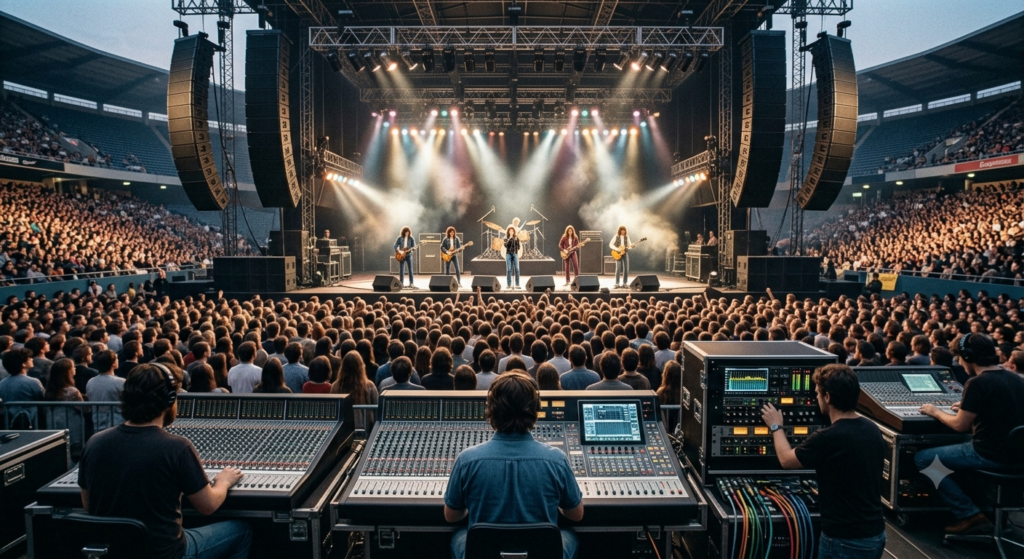
Live sound engineering is the process of capturing, processing, amplifying, mixing, and reproducing sound for a live audience. It has evolved from simple acoustic performances to highly sophisticated systems using digital consoles, wireless technology, networking, automation, and immersive audio.
Lets discuss about timeline & evolution of Live Sound :
1. Before Electronic Amplification – Acoustic Era
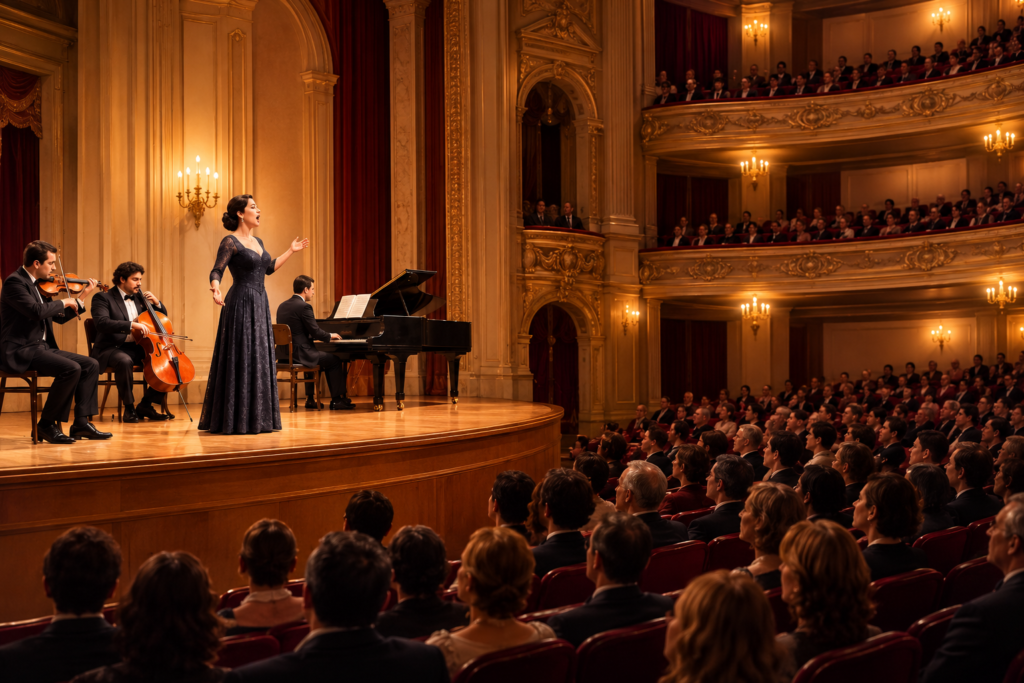
Before the early 1900s, live performances depended almost entirely on natural acoustics.
- Singers and musicians performed without microphones.
- The size and shape of the venue determined how well the audience could hear.
- Theatres, churches, and concert halls were designed with acoustic principles in mind.
- Musicians had to project their voices and instruments naturally.
- There was no electrical amplification or mixing system.
- Main limitation: Large audiences and large venues made it difficult for everyone to hear clearly.
2. The Beginning of Amplification – 1920s–1930s
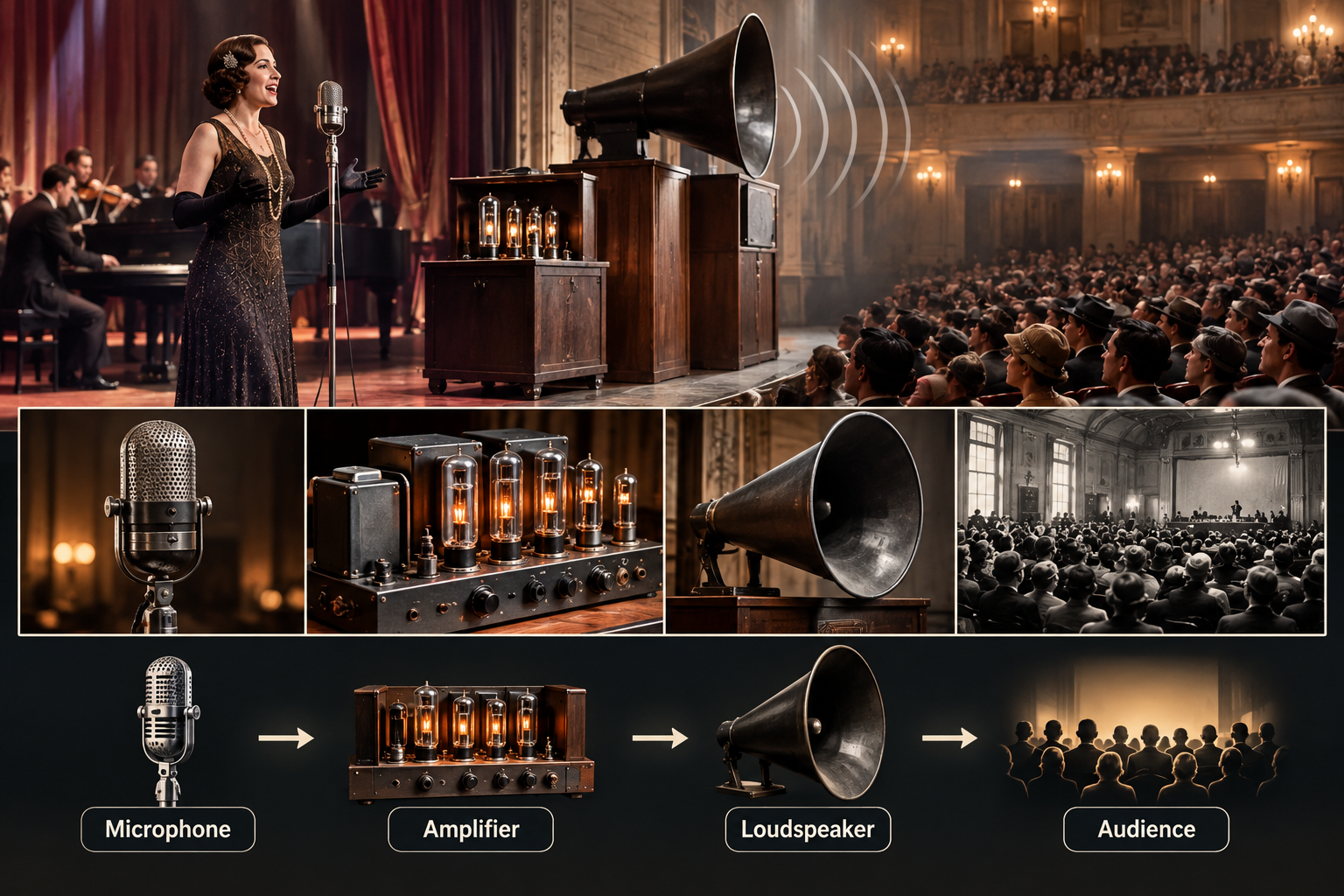
The development of the microphone, vacuum-tube amplifier, and loudspeaker transformed live performances.
- Microphones allowed performers’ voices to be converted into electrical signals.
- Amplifiers increased the strength of these signals.
- Loudspeakers reproduced the amplified sound for the audience.
- Public-address (PA) systems became increasingly common.
- Early systems were mainly used for speeches, announcements, theatres, and public events.
This period established the basic signal chain:
Microphone → Amplifier → Loudspeaker → Audience
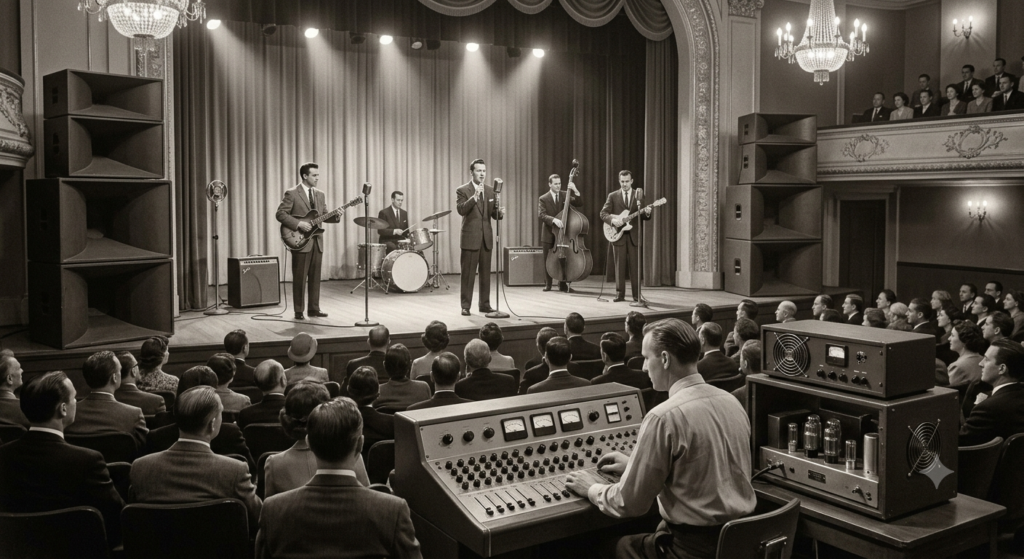
3. Development of PA Systems – 1940s–1950s
This was the period that popular music grew, PA systems became more important.
- Larger and more powerful amplifiers were developed.
- Better microphones improved vocal and instrument pickup.
- Multiple microphones could be used for different performers.
- Basic mixing systems allowed engineers to combine several audio sources.
- Early loudspeaker systems became more capable of handling larger audiences.
Live sound began to move from simply making speech louder toward reproducing music.
4. The Birth of Modern Live Sound – 1960s – Rock & Roll
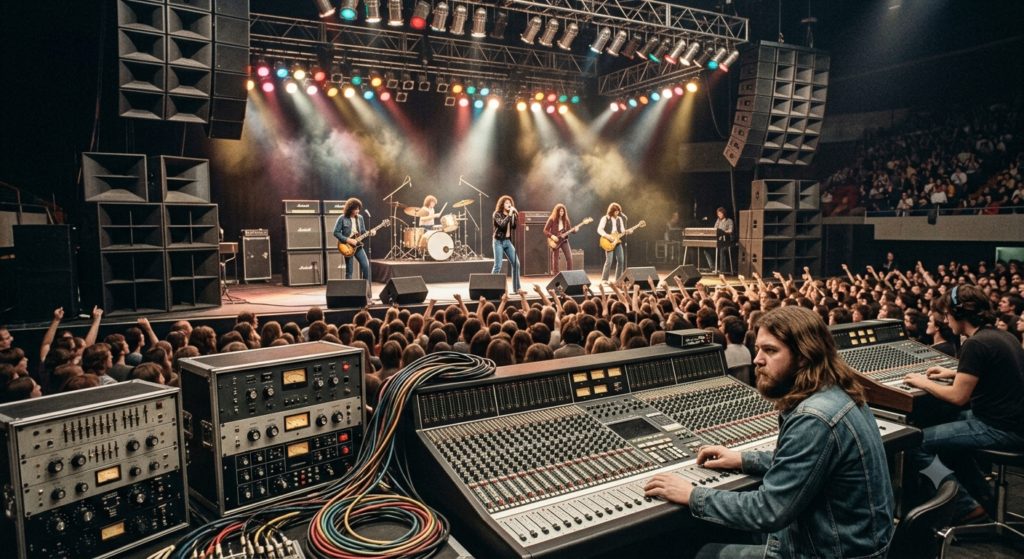
The growth of rock and roll created a major need for better live sound systems.
- Electric guitars, bass guitars, and keyboards became louder.
- Drum kits needed to compete with amplified instruments.
- Multi-channel mixing became increasingly important.
- Larger speaker systems were developed for concerts.
- Sound engineers became an essential part of live performances.
The engineer’s role expanded from operating a PA system to actively controlling the balance, tone, dynamics, and clarity of a complete band.
5. Large Concert Systems – 1970s
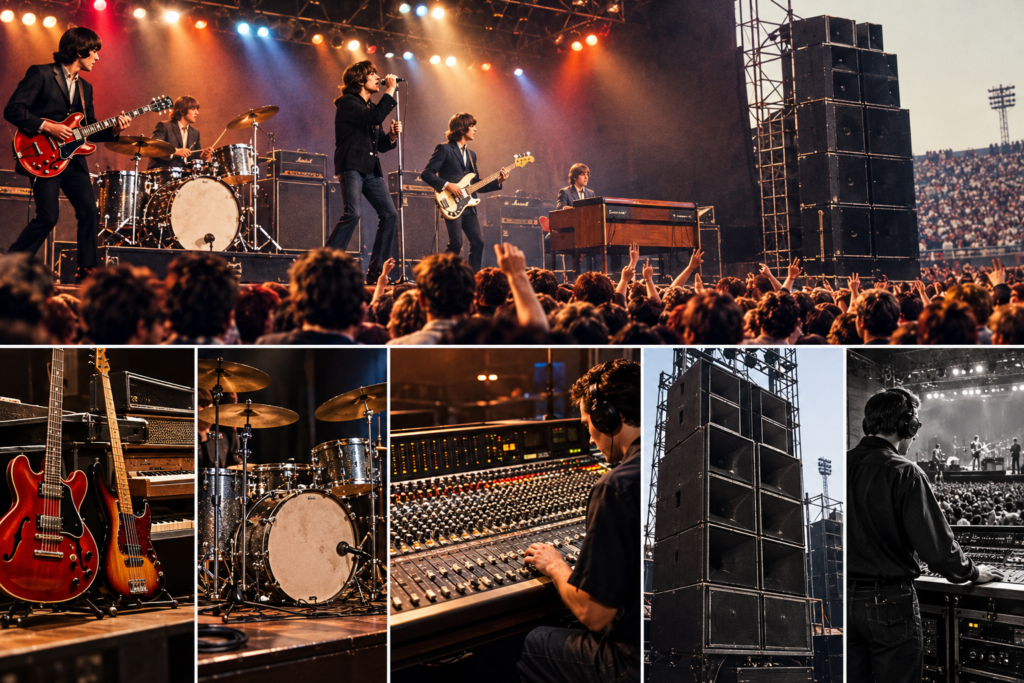
The 1970s saw major developments in professional concert sound.
- More powerful amplifiers and loudspeakers were introduced.
- Mixing consoles became larger and more sophisticated.
- Equalizers were increasingly used to control frequency response.
- Monitor systems allowed musicians to hear themselves on stage.
- Dedicated FOH (Front of House) engineers and monitor engineers became common.
- Large touring productions required specialized sound crews.
The concept of separating FOH sound from stage monitoring became an important part of modern live production.
6. Line Arrays and Large-Scale Touring – 1980s–1990s
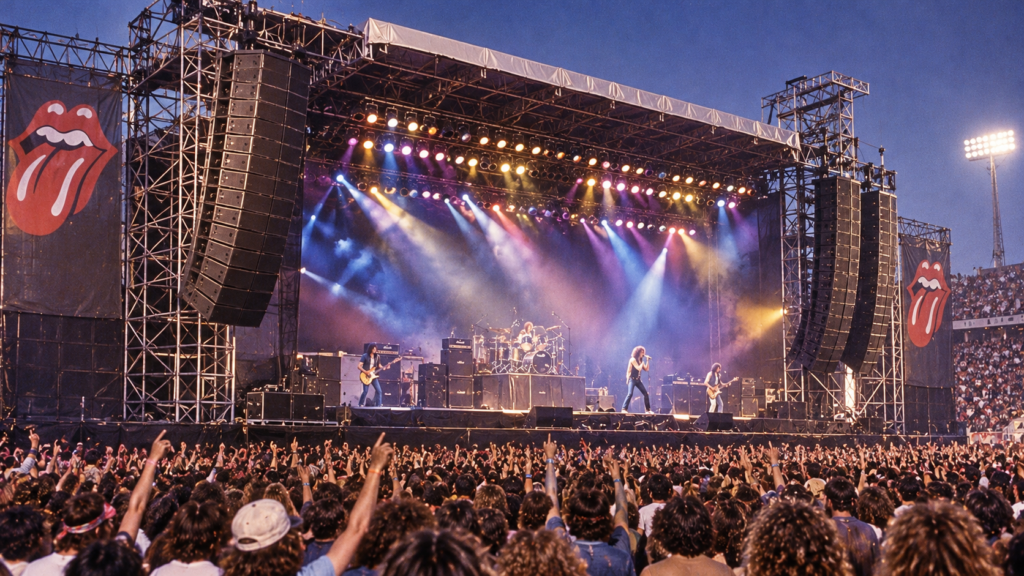
Large concerts required sound to be distributed evenly across very large audiences. Major developments included:
- More efficient loudspeaker designs.
- Improved amplifier technology.
- Digital signal processing (DSP).
- Better system equalization.
- Speaker delay systems for large venues.
- More advanced monitor systems.
- Development and widespread adoption of line-array loudspeaker systems.
Line arrays allowed engineers to control sound coverage more effectively in large venues and outdoor concerts. During this period, live sound became increasingly system-engineering oriented, not simply microphone-and-mixer operation.
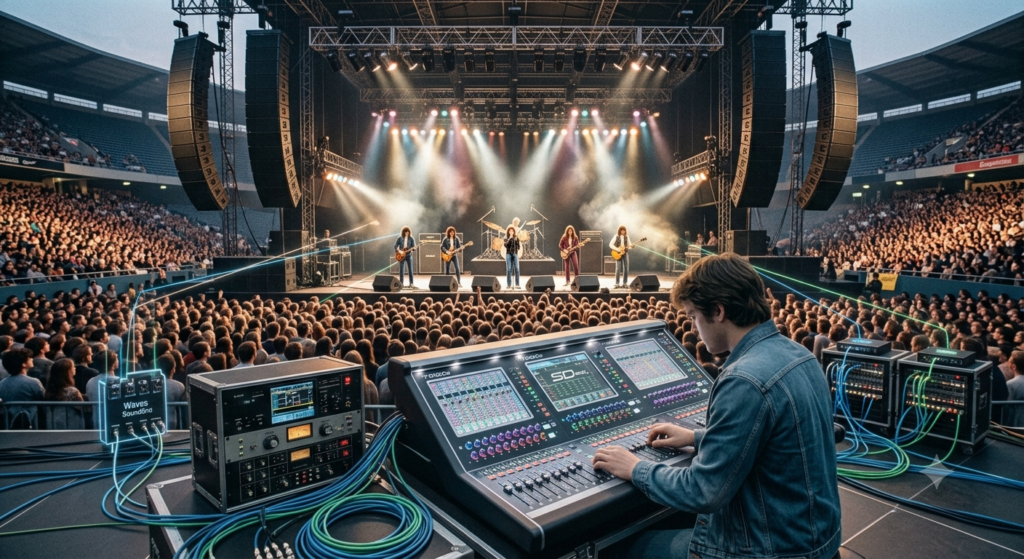
7. The Digital Revolution – 1990s–2000s
The transition from analog to digital technology dramatically changed live sound.
Digital mixing consoles introduced features such as:
- Digital signal processing
- Built-in EQ and dynamics
- Digital effects
- Scene and preset recall
- Automation
- Digital routing
- Multiple buses and matrices
- Compact control surfaces
Instead of requiring large amounts of external hardware, many processing functions could be performed inside a digital console.
The signal flow increasingly became: Microphone → Digital Stage box → Digital Network → Digital Console → DSP → Amplifier → Loudspeaker
8. Wireless and Digital Networking – 2000s–2010s
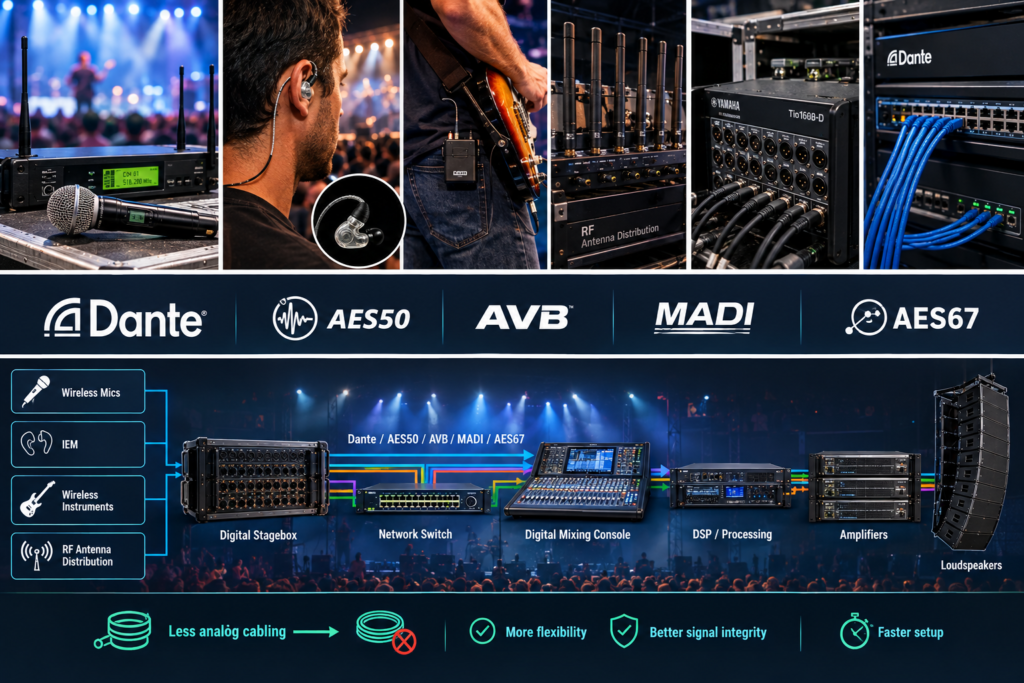
Wireless technology became increasingly important in concerts, theatre, television, and corporate events.
Common systems included:
- Wireless microphones
- In-ear monitoring (IEM)
- Wireless instrument systems
- RF antenna distribution
- Digital stageboxes
- Digital audio networking
Technologies such as Dante, AES50, AVB, MADI, and AES67 allowed multiple channels of digital audio to travel between consoles, stageboxes, computers, and other equipment. This greatly reduced the amount of traditional analog cabling required.
9. Modern Live Sound – 2010s–Present
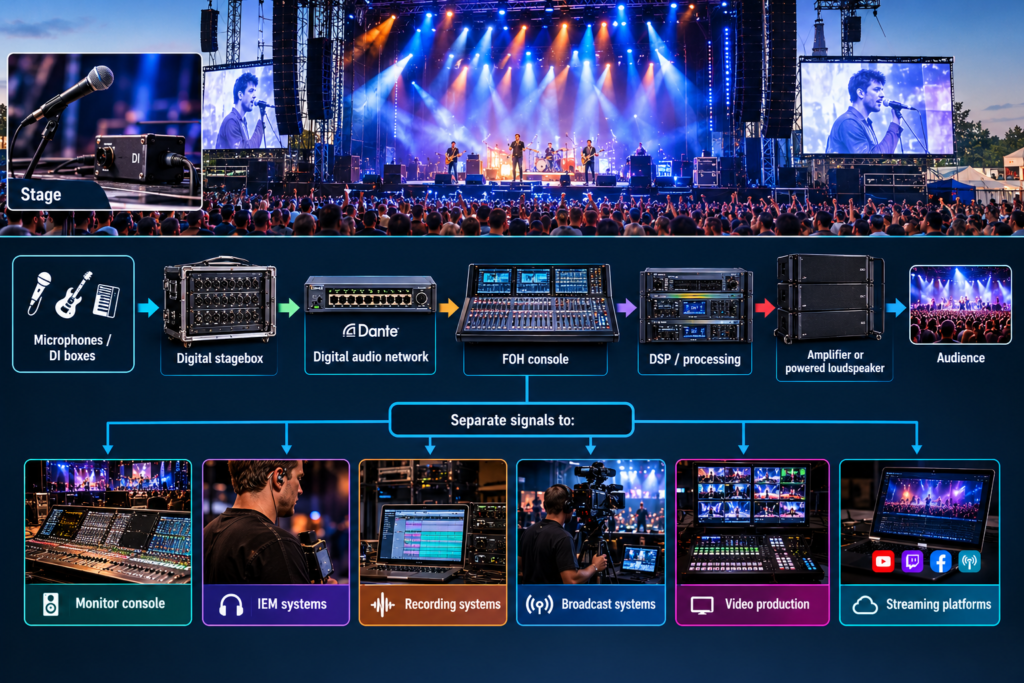
Today’s live sound systems are highly integrated digital environments.
A modern concert may include: Microphones / DI boxes → Digital stagebox → Digital audio network → FOH console → DSP / processing → Amplifier or powered loudspeaker → Audience
At the same time, separate signals can be sent to:
- Monitor console
- IEM systems
- Recording systems
- Broadcast systems
- Video production
- Streaming platforms
10. Immersive and Spatial Audio
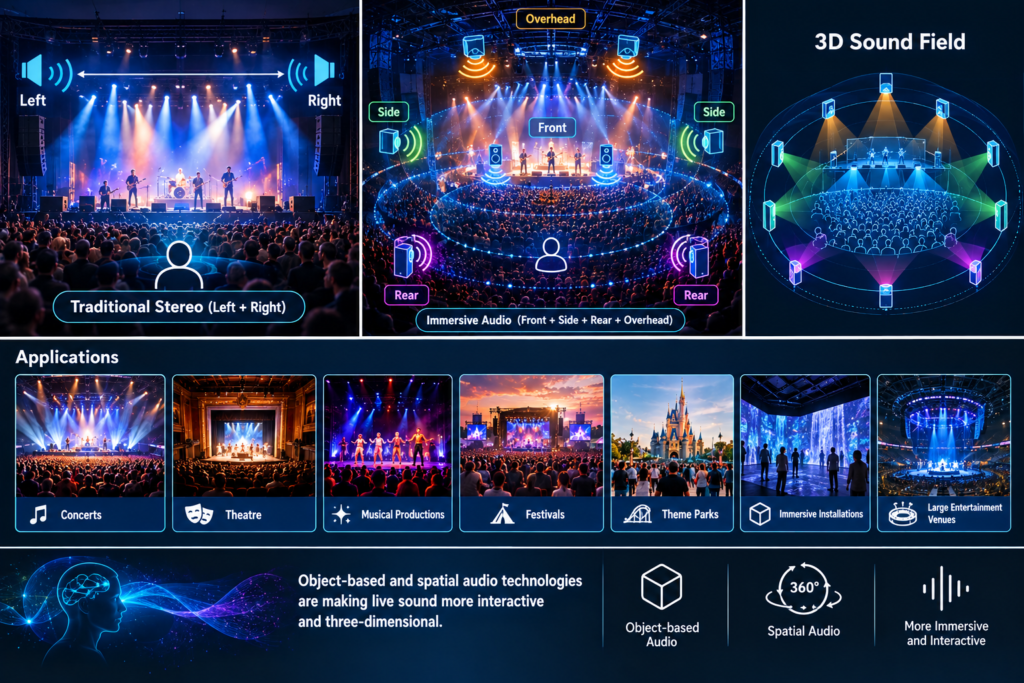
One of the newest developments is immersive live audio. Traditional live sound is generally based on a left-right stereo system: Left + Right → Audience
Immersive systems can use multiple loudspeakers around the audience: Front + Side + Rear + Overhead → 3D Sound Field
This allows engineers to position sounds within a three-dimensional space. Applications include:
- Concerts
- Theatre
- Musical productions
- Festivals
- Theme parks
- Immersive installations
- Large entertainment venues
Object-based and spatial audio technologies are making live sound more interactive and three-dimensional.
Evolution Summarize
| Period | Major Development |
| Before 1900 | Acoustic performance |
| 1900–1920 | Early microphones and electrical audio |
| 1920s–30s | PA systems and amplification |
| 1940s–50s | Multi-microphone and basic mixing |
| 1960s | Rock concerts and professional live engineers |
| 1970s | Large touring systems and monitor mixing |
| 1980s–90s | Advanced PA, DSP and line-array development |
| 1990s–2000s | Digital consoles |
| 2000s–2010s | Digital networking and wireless systems |
| 2010s–2020s | Networked, highly integrated digital systems |
| Today | Immersive audio, advanced DSP, automation and IP-based audio |
Live Sound Engineering Course in Chennai
If you are passionate about audio technology and want to build a career in the live entertainment industry, Soundpoint Pro, Chennai, offers professional Live Sound Engineering courses with practical, hands-on training. Learn the fundamentals of sound reinforcement, professional audio equipment, digital mixing consoles, microphone techniques, speaker systems, signal processing, system configuration, stage monitoring, and large-scale concert sound management. Our Live Sound Engineering training in Chennai provides industry-oriented knowledge and practical experience to prepare you for professional careers in live events, concerts, touring productions, and audio production. Join Soundpoint Pro to learn Live Sound Engineering in Chennai and take your first step towards becoming a professional Live Sound Engineer.
Conclusion
Live sound engineering has evolved from acoustic sound projection into a highly technical field combining audio engineering, acoustics, electronics, RF technology, digital signal processing, networking, and system design.
The fundamental goal has remained the same—to deliver clear, balanced, powerful, and reliable sound to an audience. However, modern engineers can now control hundreds of audio channels, remotely manage loudspeaker systems, use sophisticated DSP, transmit audio over networks, provide personalized IEM mixes, and create immersive three-dimensional sound experiences.
In simple terms: Acoustic performance → Amplification → PA systems → Multi-channel mixing → Large concert systems → Digital audio → Networked audio → Immersive live sound.